Introduction
Open source software is everywhere, most of the products and services we use daily are built on top of it. In 2024, GitHub alone reported 5.2 billion contributions across 518 million open source projects.[1] But despite this scale, many projects are quietly dying. Survival rates for open source repositories have been falling steadily, not just obscure ones, but even well-known projects are losing activity, maintainers, and community support.
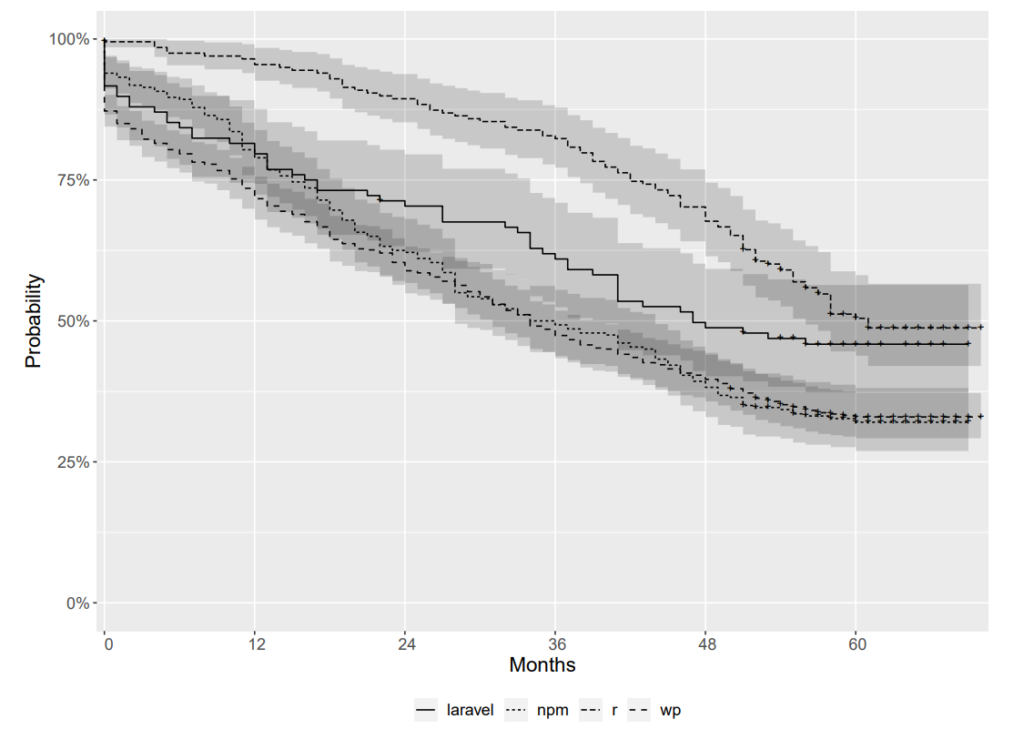
Why? Contributing to open source is intimidating. Even experienced developers struggle to find the right project, understand an unfamiliar codebase, or navigate the social dynamics of a public PR. For beginners, it can feel impossible.
Inherit is a YSWS (You Ship, We Ship) program that aims to fix this, by giving Hack Club members a structured, supported, and rewarded path into open source contribution. Because collaborative building and learning from each other is at the core of what Hack Club is about.
Concept
Inherit is built for Hack Club members who want to contribute to open source but don't know where to start. The core idea: find an abandoned project, make it better, open a PR, and get rewarded. Not just for the code, but for the experience of actually doing it.
Why "Inherit"?
The dictionary definition of inherit is "to receive or be left with a situation or object from a predecessor." That's exactly what this program is about. You inherit a project from someone who built it, got busy, and moved on. You work on it, leave your mark, and pass it forward for the next person.
Tracking Contributions
Contributions are tracked using Hackatime, which runs quietly in the contributor's editor and logs time automatically. Every 2–3 hours of tracked time, a Slack bot checks in and asks for a short summary of what was built, keeping a transparent record without disrupting the workflow. These check-ins are opt-out, and contributors can always submit summaries manually through the dashboard instead.
Rewards and Recognition
Contributors set their prize goal upfront, before they start working. The bigger the commitment, the better the reward. Current prizes include the GitHub Badger 2350 hackable badge, GitHub playing cards, the book Working in Public by Nadia Asparouhova, and Hack Club stickers. Contributors can also choose to donate the equivalent value to a charity of their choice via Every.org instead of receiving a physical prize.
Project Recommendation System
Finding the right project to contribute to is half the battle. Inherit's recommendation engine matches contributors to projects based on their tech stack, interests, and experience level, gathered through an optional onboarding form that can be updated at any time. Contributors can also browse and filter the full project index manually, and are free to work on any project they choose regardless of what gets recommended.
Projects are indexed through a combination of automated scraping of past Hack Club hackathon submissions and manual submissions from project authors. The index includes metadata like language, difficulty level, and last activity date, helping contributors find something that fits.
Design
Design Philosophy
Inherit isn't a SaaS. It's a community program with a human story behind every project in its index. A clean, minimal design would contradict that, it would make Inherit feel like a tool rather than a place. The warmth of the hand-drawn aesthetic mirrors the warmth of the concept itself: something built by people, for people.
Every design decision was made to feel like it belongs in the same world as the illustrations, rough edges, warm colors, things that look made rather than generated.
Color Palette
The entire site uses four shades derived from the logo:
-
#FFBF8F, light brown, warm highlights and glows -
#AA5F27, mid brown, buttons, accents, headings -
#7E471F, dark brown, borders, shadows -
#3D2008, near-black brown, primary text
These weren't chosen arbitrarily, they came directly out of the logo. The background is a warm paper tone rather than pure white or black, which keeps everything feeling cohesive and grounded.
Logo Design
Current version
Earlier version
The logo is a wooden plaque, plaques commemorate things, they mark legacy and history. Orpheus peeks over the top, watching a small plant sprout from the wood. The plant is the key symbol: something abandoned growing again. The hand-drawn lettering is intentionally imperfect, matching the overall aesthetic.
The earlier version had Orpheus sitting on top of the plaque with a rougher, sketchier style. The current version adds shading, a cleaner composition, and the sprout detail that ties the revival metaphor together.
Illustrations
Every illustration on the site was drawn from scratch in Figma, no stock art, no AI-generated images, no third-party libraries. The hand-drawn style was a deliberate choice to contrast with the generic SaaS aesthetic that dominates most YSWS sites.

Inherit's hand-drawn style

Generic undraw.co equivalent
Typography
Inherit uses Phantom Sans, Hack Club's own custom typeface. Using it was a deliberate choice to feel native to the Hack Club ecosystem rather than importing a generic font. Phantom Sans has rounded edges and an informal character that complements the hand-drawn illustrations without competing with them.
Implementation
Webpage
The site is built with SvelteKit and TypeScript, styled with SCSS. Vercel handles hosting
and deploys automatically on every push to main. The custom domain inherit.dino.icu is configured via the hackclub/dns
GitHub repository.
Forms and RSVP
RSVPs are handled through Fillout. When a user types their email on the landing page and hits Join, they're redirected to the Fillout form with their email pre-filled, one less thing to type.
Contribution Tracking
Hackatime runs in the contributor's editor and tracks coding time automatically, no manual logging. Every 2–3 hours a Slack bot checks in for a short update. These check-ins can be turned off at any time. Time data determines prize eligibility.
Charity Donations
The charity option runs through Every.org, which vets every nonprofit on its platform. Contributors pick any listed organization, the donation is processed via Hack Club Bank, and the contributor gets a receipt and a personal thank you via Slack.
Design and Illustration
All visuals, logo, step illustrations, section dividers, step numbers, background textures, UI frames, were designed and drawn in Figma and exported as SVGs. Everything is original.